What Gaussian Splatting Actually Is In Plain Language
A genuinely useful technology explained without the jargon
TECHNOLOGYNEW TECH
6/15/20263 min read
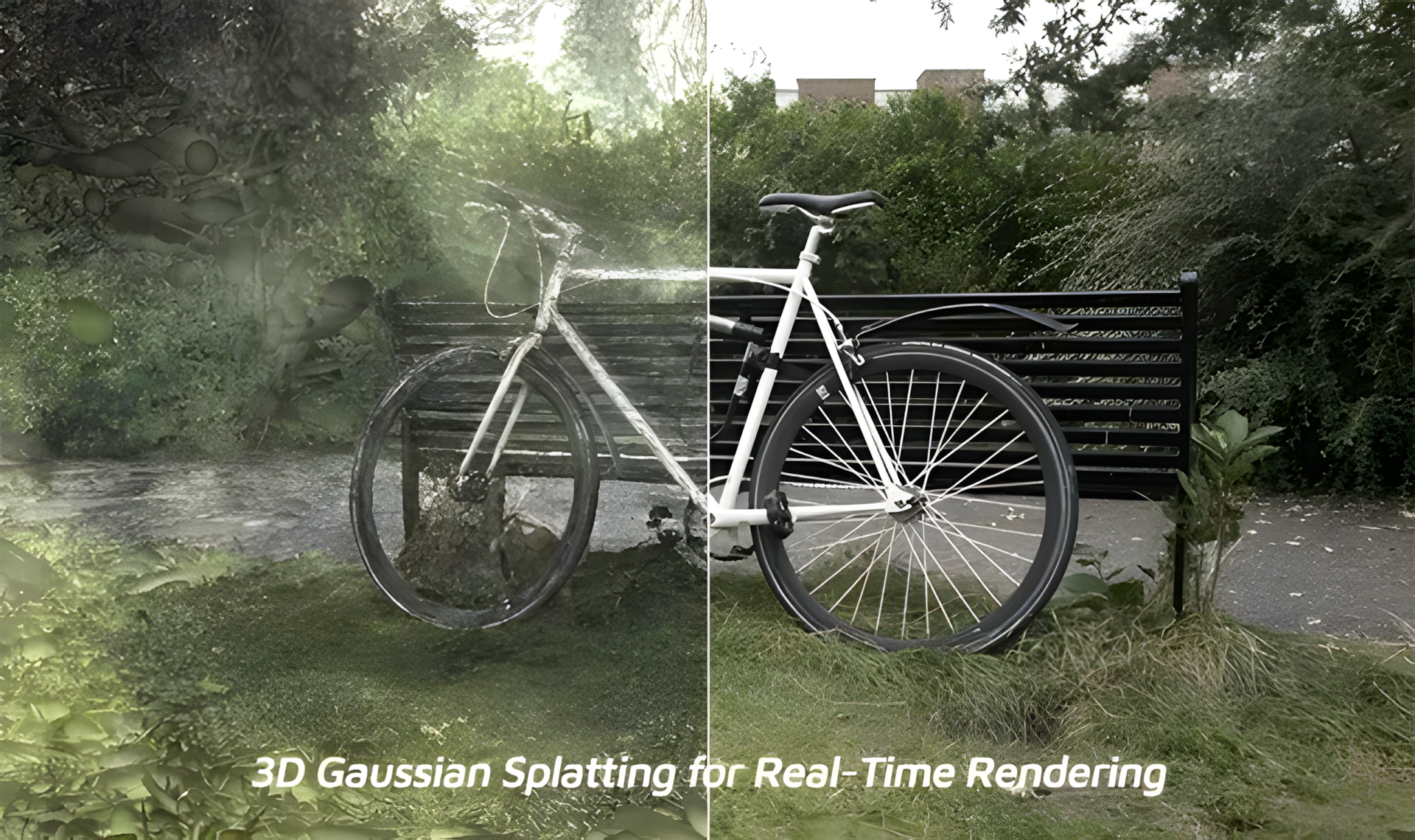
You've probably seen the term. It sounds complicated because it is, technically. But the idea behind it is worth understanding particularly if you're a brand thinking about interactive product experiences, virtual walkthroughs, or anything that needs to look photorealistic in real time.
How traditional 3D works
Traditional 3D models are built from polygons triangles and quads that form the impression of surfaces. A sphere is actually a many-sided polygon object that looks curved when you view it from far enough away. This is how almost everything in 3D has been made for decades, and it's the foundation of most product visualization, film VFX, and game production.
It's a powerful approach, but it requires skilled artists to build every surface manually. The model has to be constructed, textured, lit, and rendered. For photorealistic results, this pipeline is time-intensive and requires significant expertise.
What Gaussian splatting does differently
Gaussian splatting works from the opposite direction. Instead of building a 3D model from scratch, you start with a set of real-world photographs of the subject a room, a product, a building, a landscape taken from many different angles. The software analyses these photographs and reconstructs what the space must look like in three dimensions.
The reconstruction isn't made of polygons. Instead, the software generates a cloud of millions of tiny semi-transparent ellipsoids the "Gaussian splats." Each splat stores information about colour and opacity from different viewing directions. When these splats are rendered together from any given viewpoint, they recreate the appearance of the photographed scene with remarkable accuracy.
The result looks photorealistic because it is, in a sense, derived from real photographs. And it's fast enough to run in real time, in a browser, on a phone.
Where it's genuinely useful
Gaussian splatting is particularly well-suited to situations where you want to capture something that already exists and present it interactively. A hotel suite that needs a virtual walkthrough for booking pages. A showroom that needs to be accessible online. An existing product that needs an interactive 360-degree viewer. A heritage space that needs to be preserved digitally.
The capture process is relatively fast compared to traditional 3D scanning or modeling. A photographer with the right equipment and process can capture a room in a morning. The processing takes longer, but the result is a navigable, photorealistic representation of that real space.
For brands with existing physical products or spaces, Gaussian splatting offers a pathway to interactive 3D experiences that bypasses the traditional modeling pipeline entirely.
Where it falls short
The most significant limitation is editability. A Gaussian splat is a capture, not a construction. You can view it from any angle, but you can't easily move an object, change a surface material, or alter the lighting. The scene is locked as it was photographed.
This makes Gaussian splatting a poor choice for anything requiring variation different colourways, different configurations, different environments. For that work, traditional 3D modeling remains the right approach because the scene can be changed non-destructively.
Shiny, reflective, or transparent surfaces also present challenges. Glass, polished chrome, and water confuse the reconstruction algorithms because their appearance changes dramatically with viewing angle. The software has difficulty interpreting surfaces whose visual information isn't stable across photographs.
File size is another practical consideration. A single Gaussian splat scene typically runs between 100 and 300 MB. For web delivery, this requires either a streaming approach or significant compression, both of which add technical overhead.
The right question
Like most technologies, the value of Gaussian splatting depends entirely on what you need it to do. For capturing existing spaces and products in an interactive, photorealistic format it's a genuinely powerful tool that's getting faster and more accessible quickly. For creating imagery that doesn't exist yet, or that needs to be changed and reconfigured traditional 3D remains the more versatile choice.
The two approaches are increasingly being used together: traditional 3D for the hero product, Gaussian splatting for the environment it sits in. That combination is where some of the most interesting work is happening right now.
Credit
Image from "How 3D Gaussian Splatting Works: A Technical Guide," by KIRI Engine, April 25, 2025, https://www.kiriengine.app/blog/3d-gaussian-splatting-a-technical-guide-to-real-time-neural-rendering